

Hourly vs Project Pricing: Which One Should I Choose?
Here's how to know which structure fits your work, life, and client.


People always talk about hourly pricing versus project pricing as though there is one correct answer. The whole debate is actually a lot more practical than that.
The ultimate question is…
Which pricing structure actually serves the kind of work you do, the kind of client you serve, and the life you want to build?
Pricing is not just about numbers. It is about your comfort level, your market, your experience, your client type, your delivery style, and the general idea of how you want to structure your life. That is the part many people miss.
It is easy to talk about pricing in a highly theoretical way, but once you actually start freelancing, you realise very quickly that pricing affects everything.
Pricing can decide whether something feels contained, and sustainable, or whether it quietly turns into one of those endless engagements where you are constantly doing more than what you originally agreed to.
Before we even talk about what to charge, it helps to first understand the structure you are choosing.
The Basic Difference
There are many ways to quote or price your work, but the two most common pillars are:
Hourly pricing means you decide what your rate is per hour, and the client pays according to the number of hours worked or physically blocked for them.
Project pricing means you quote a fixed price for a defined scope of work, based on the type of project, the deliverables, the terms, and the value of what is being created.
A quick note if you are still shaping your first offer:
I go deeper into this inside The First Freelance Offer Kit, especially in Module 4: Quote & Confirm.
That module is where I break down how to turn your offer into a simple quote, determine your rate card, define what is included, confirm the scope, and avoid leaving the arrangement vague.
Before you can price your work clearly, you need to know what you are actually quoting.
Neither is automatically superior.
Some freelancers have a clear service menu with fixed prices attached. Others choose to keep their offers private and price entirely based on each enquiry. Some work on retainers, monthly hour blocks, credits, day rates, or session blocks.
Pricing is not a clean, static formula you copy and paste forever. It ultimately is your call, based on your working relationships.
1. Project-based Pricing
Project-based pricing is what most people point to when they discuss high-value, outcome-driven freelance work. You are not charging purely for the clock; you are charging for a defined outcome, a deliverable, or a transformation.
The core premise: this is the project, this is the scope, this is the value of the work, and this is the fixed price.
This model works especially well when the work has a clear beginning, middle, and end.
For example: a brand identity, a website, a pitch deck, a publication, a strategy document, a campaign concept, a set of templates, a workshop design, or a clearly scoped deliverable.
Pros of project-based pricing
You can usually price higher.
Because you are not tying your effort directly to time, you can price based on your expertise, the complexity of the scope, the deliverables, and what the work allows the client to do.You can set the tone of the engagement from the start.
A project quote allows you to define what is included, what is excluded, the timeline, the number of revision rounds, and how the engagement should move.There are more packaging and upselling opportunities.
You can present tiered options, add-ons, or optional extensions depending on what the client needs.You are not punished for being fast and efficient.
If you can complete a high-quality deliverable quickly because you have experience, templates, systems, or a sharper process, you do not earn less just because you are fast.You can protect your project margin.
When your process is strong and the scope is controlled, project pricing can offer healthier margins than hourly work.You get more control over your schedule.
For remote, output-based assignments, you can manage your own time as long as you hit the agreed milestones.You can create a clear payment schedule.
For example, a 50% upfront deposit, a milestone payment, and a final completion fee.
Cons of project-based pricing
Value can be subjective.
What feels like a reasonable investment to you may feel expensive to a client who does not understand the thinking, experience, and labour involved. Then, it’s on you to sell that value effectively, which can be a mammoth task.Approval may take a longer time.
Depending on your client, you may be subject to procurement policies that require multiple decision makers to sign off on the pricing.Expectations can differ.
You may assume the project involves one clear scope, while the client assumes it includes a dozen other “small” requests, or extra service touches.There is the “infinite changes” trap.
Some clients assume a fixed price means endless revisions unless your terms clearly state otherwise. Even so, there is a tendency to ‘nudge’, it is on you to hold your ground.Timelines can stretch.
If feedback gets delayed, stakeholders multiply, or approvals stall, a project can drag on much longer than expected. This is something people don’t mention and it’s not in your control.You may underestimate the actual labour.
People love saying project pricing means you can finish something quickly and still get paid the full amount. And yes, in a best-case scenario, that is true. But in real life, scopes can shift, feedback can drag, and your calculated hourly average can drop very quickly.You need strong scope control.
If you do not define what is included and what is not, project pricing can turn messy very fast.
Project pricing is powerful, but only if you have proper scope, proper boundaries, proper terms, and a very clear idea of what the engagement actually includes.
2. Hourly Pricing
Hourly pricing is more straightforward. You establish your rate per hour, and the client pays for the time worked or the time blocked out on your calendar.
This works especially well for ongoing, roster-based, on-site, consulting, teaching, or facilitation-heavy engagements.
The core premise: this is my time, this is my rate, and this is the number of hours required.
Hourly pricing is often dismissed online because people associate it with “trading time for money.”
And yes, there is some truth to that, but that does not automatically make hourly pricing bad.
For certain kinds of work, hourly or day rates are actually the cleanest and most sensible structure.
If your value depends on your live presence, real-time guidance, physical attendance, or active delivery, then time is not just a random unit, it’s part of the work.
Pros of hourly pricing
It is simple to calculate and track.
There is a clear unit of measurement. If you work more hours, you charge more hours.It is easy for clients to understand.
Sometimes clients do not need a complex package. They just need to know your hourly cost, how many hours they need, and what can be done within that time.It works well for rostered or face-to-face work.
If you are booked for training, teaching, facilitation, or live sessions, your physical presence is part of the value. Hourly or day rates track this clearly.Scope expansion is easier to manage.
If a client expands the brief, you do not always need to renegotiate a whole new project fee. You can simply add the additional hours.There are natural calendar boundaries.
If a client books you from 9am to 12pm, that is the agreed time block. Anything beyond that can be treated as additional time, and the client knows that additional hours, means additional costs.It gives schedule predictability.
Hourly, session, or day rates can help you map out your week, your capacity, and your rest more clearly. This is great when you are also running multiple projects in your own spare time.Reduced mental load.
When the time block is over, the work is over. You do not need to hold or carry the project around with you after the block is done.
Cons of hourly pricing
You may need to time-track.
This is especially true if you are working directly with a client and charging based on actual time worked.You are still trading time for money.
There is a physical ceiling because there are only so many hours in a day.It can penalise speed and mastery.
As you become better and faster, you may technically get paid less for the same deliverable unless you keep raising your hourly rate.There are hidden time costs.
For on-site roles, a three-hour delivery window may actually take five or six hours once you include travel, setup, waiting, packing, and buffer time.Preparation time needs to be accounted for.
If the client only pays for delivery hours but the work requires research, customisation, materials, or extensive planning, your actual take-home rate drops unless you build that into the quote.Recovery time matters.
For facilitation, teaching, training, or people-facing work, the time spent delivering is not always the only energy cost.A blocked schedule has opportunity cost.
Saying yes to one time block means saying no to another opportunity during that same window.
Hourly pricing is not bad. It is just a different structure. It gives clarity, but it also has a ceiling. Project pricing gives flexibility and margin, but it requires stronger scope control.
Quick Comparison
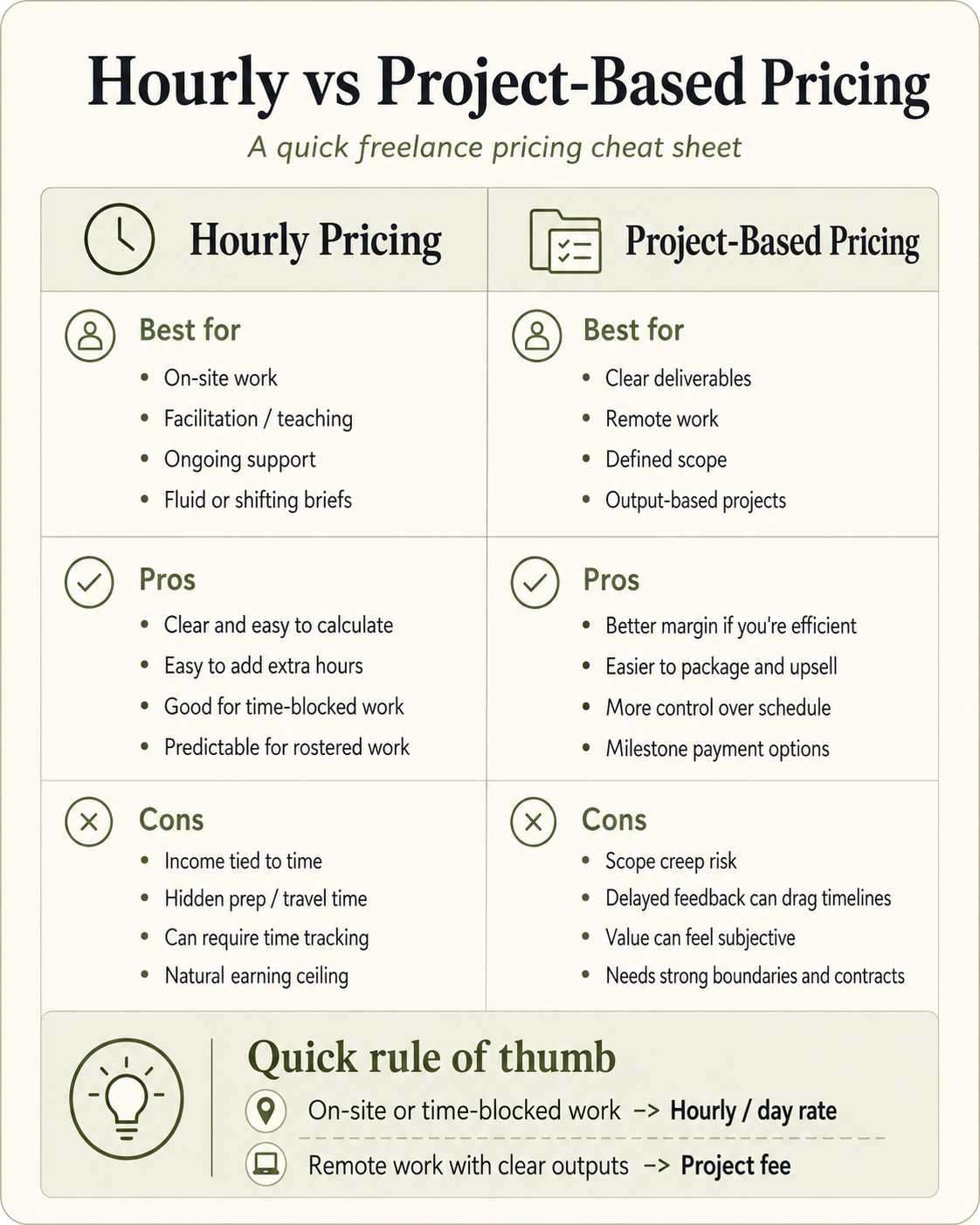
Project-Based Pricing
Best for: Clear outcomes, remote delivery, defined deliverables, fixed scope, and output-based work.
Main risk: Scope creep, delayed feedback, extra stakeholders, and long timelines eating into your margin.
Hourly / Day Rate
Best for: On-site work, live facilitation, teaching, consulting, rostered work, advisory support, and shifting briefs.
Main risk: Capped earning potential, hidden prep time, travel time, recovery time, and calendar limits.
So, Which One Should You Choose?
It all depends on which structure best matches the nature of your work.
If the work depends heavily on live presence, time blocks, on-site delivery, teaching, facilitation, consulting, or ongoing support – hourly rates, day rates, or session blocks may serve you better. Your focused time and attention are the unit of exchange.
If the work is remote, output-based, clearly scoped, and tied to a defined deliverable – project pricing may give you more margin, flexibility, and control. Your outcome is the unit of exchange.
If the scope is clearly defined and the deliverables are fixed, use fixed pricing and document it properly. Define the deliverables, revision rounds, timeline, payment terms, and what happens if the scope changes.
If the scope is vague, experimental, advisory-heavy, or likely to move, use hourly pricing, a day rate, a retainer, or phased pricing. Do not trap yourself in a fixed price for a project that is obviously going to keep changing.
The goal is to pick the pricing structure that protects the work, protects your energy, makes sense to the client, and supports the kind of working life you are actually trying to build.
That is The Good Yield.
In Part 2, I’ll go deeper into the next question: once you understand the structure, how do you actually decide what to charge?
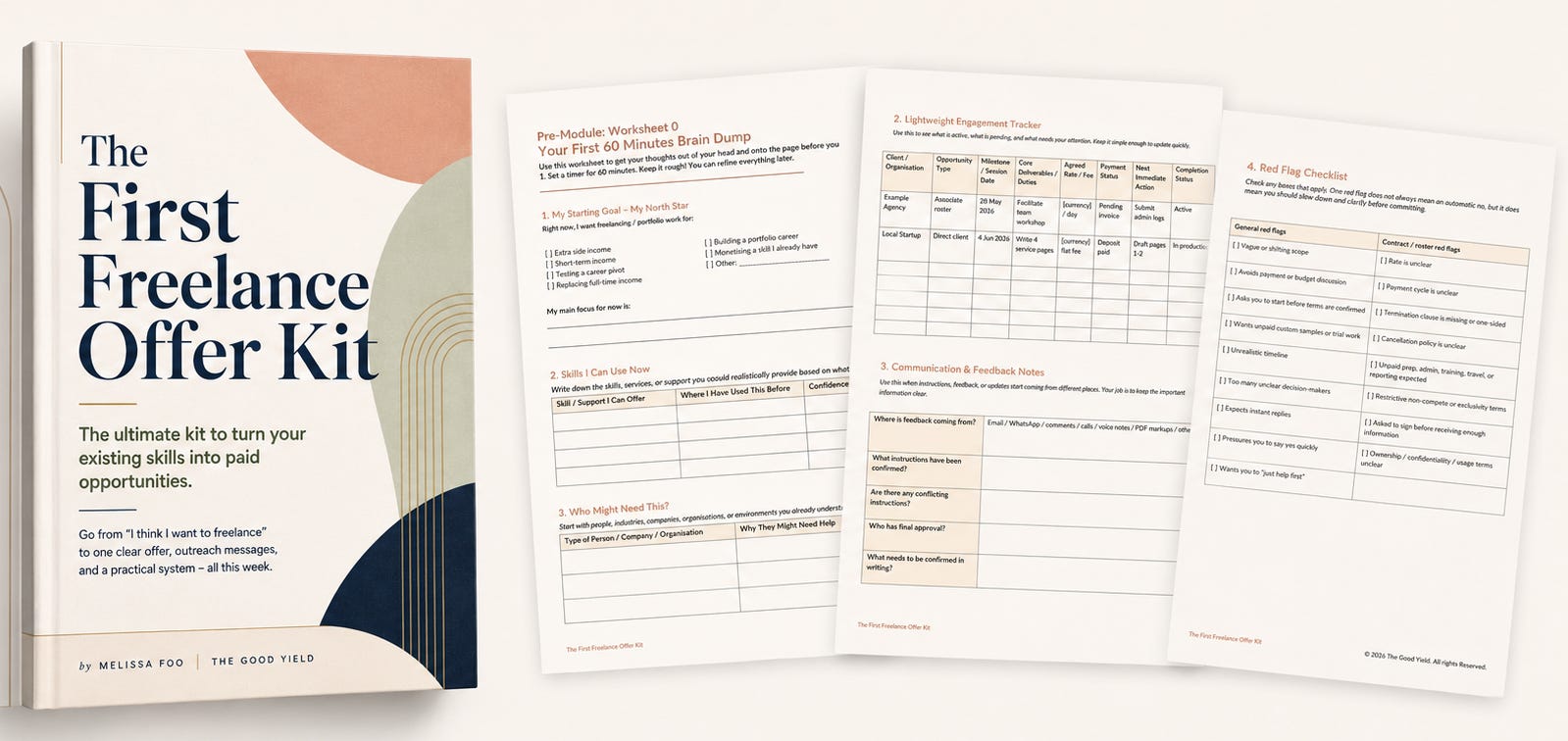
P.S. If you’re at Step Zero, I created [The First Freelance Offer Kit] to help you turn your existing skills into a testable offer.
It’s built for that exact moment when you know you have valuable experience, but you’re not sure how to package it or start putting it out there.
Melissa Foo is the writer behind The Good Yield, a publication about adaptive work, career pivots, freelancing, and building a resilient working life. She began as the founder and creative lead of her own design studio before moving into facilitation, education, design thinking, and portfolio work.
Love this so much, such a valuable read! This is exactly what my younger self needed when starting out in freelancing. Reading it now feels like a full-circle moment, it's both a great reminder for my current business and a handy resource to keep close by 👏